Compatibility
Keep the system you run.
Add the layer it was never built to give you.
Your operating system does its job at the top of the company. What it cannot tell you is whether the sixty people underneath your leadership team understand the direction they are being asked to execute.
That is the only thing Pulse Connect measures.
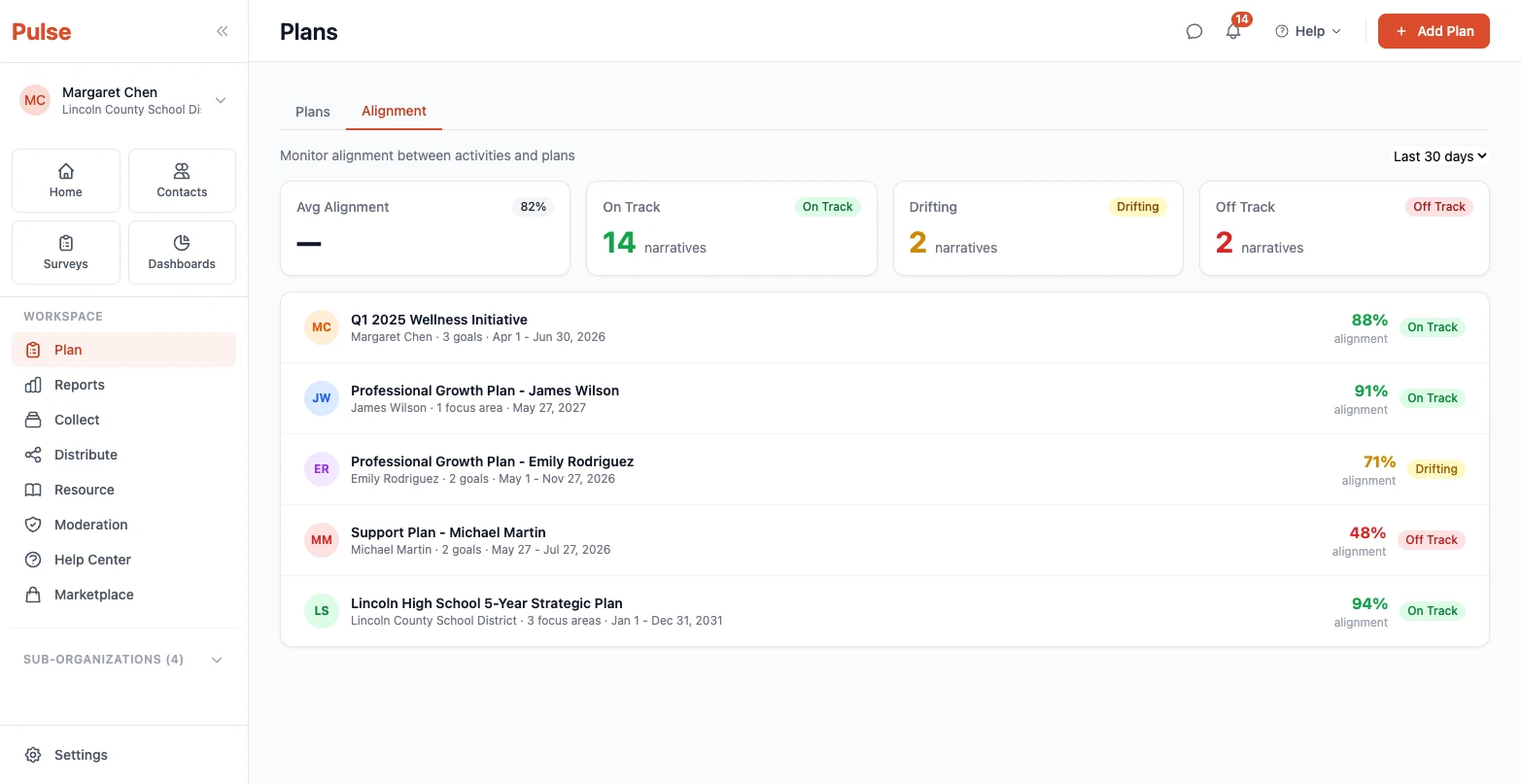
Comprehension by priority, cycle over cycle
Where this sits
Three layers. Most companies only have two.
Your methodology sets direction. Your system of record holds the leadership team to it. Neither reaches the people doing the work.
Layer 1
Methodology
The framework your leadership team runs on. Sets the priorities, the cadence, and the language everyone uses.
Owned by your implementer or your leadership team
Layer 2
Leadership system of record
Where the priorities, numbers, and issues live week to week. Keeps the leadership team honest about what it committed to.
Owned by your existing software
Layer 3
Comprehension below the leadership team
Whether the people executing the strategy understand it, believe it, and have what they need to move it. Measured directly, from them, on a cycle.
This is the layer Pulse Connect owns
Layers one and two are about the leadership team. Layer three is about everyone else. That is why adding it changes nothing above it.
The boundary
A list of things we will never build.
Most vendors in this space eventually absorb the system you already run. We will not build any of the following, in any release, under any name. In public, so you can hold us to it.
Weekly leadership meeting tooling
No agenda runner, no meeting timer, no rating system. That meeting belongs to the system you already run.
Scorecard and metric management
No weekly number tracking, no metric ownership. If those numbers already live somewhere, they stay there.
An issues list
No issue capture, prioritization, or resolution tracking. Surfacing a gap is not the same as managing the issue it creates.
Vision and planning document editing
No editor for your planning documents. We read the priorities you already set. We do not host or replace them.
Want any of the four? We will name a tool that does it well and not try to talk you out of it.
In practice
Nothing about your current rhythm changes.
Your planning session happens exactly as it does now.
Same facilitator, same agenda, same output. We read the priorities that come out of it. We are not in the room.
Your team answers a short check-in on a cycle you set.
Under three minutes, from a phone. No login, no dashboard to adopt, no training. The only new thing anyone below your leadership team ever sees.
Your leadership team gets the gap, by priority and by group.
Which priorities have real comprehension and which run on assumption. Responses stay anonymized: you see patterns, never people.
You act inside the system you already run.
The gap becomes an item in your existing process, owned by whoever owns that priority. We hand you the finding. Your system handles the response.
If we are not the fit
We would rather refer you than sell you.
We are wrong for you under a year on your operating system, under twenty five people, with no company-wide meeting rhythm, or if what you want is a leadership meeting tool or an engagement survey. We will say so on the first call and point you somewhere better.
Where we send people
- You want leadership meeting and scorecard tooling. Several good platforms do exactly that. We will name the one that fits your size.
- You want to know how your people feel about working here. That is an engagement survey. The incumbents do it well, and it measures something genuinely different.
- You want to track whether the plan is moving. That is strategy execution software. We measure something upstream of what it reports.
Ready to see the gap
Thirty minutes, and we will tell you if this is not for you.
We will ask how long you have run your system and where you suspect the direction stops landing. If we are not the right instrument, we will say so on the call.